
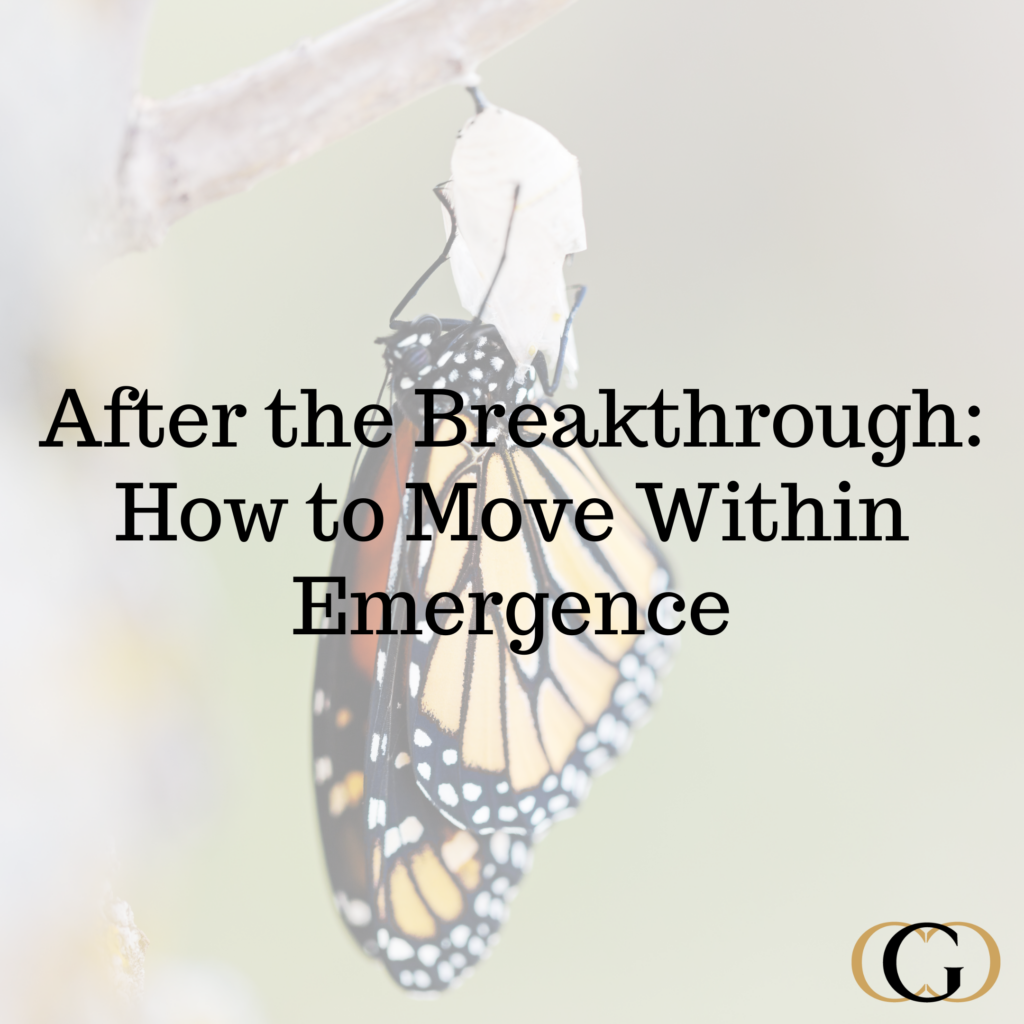
As promised, this episode is what happens when you are experiencing: Emergence.
And for a general definition, Emergence is the precise tipping point where your internal alignment becomes heavier, stronger, and more real than external pressure. When your internal coherence stabilizes, your body, your truth, your boundaries, and your choices stop fighting one another. They align into a single, unified frequency. Emergence is the structural event that occurs when that internal stability forces your outer world to reorganize around it.
Today I’m going to talk about what this was like from my own experience within it and now currently constructing a new reality as I’m moving through it. But let me say this first: Emergence doesn’t happen as you expect it to. It’s not something you can prepare or plan for. You have no control over how it manifests and the options available to you during it. And one thing is for certain: you will be asked to face your fears, do the hard things, have the hard conversations, be radically honest with yourself, and most importantly, stay true.
Part 1: After Entering Emergence
What you feel immediately after entering an emergent state is rarely neat or obvious – it’s usually quiet, disorienting, or even anti-climactic. When you first cross the edge of coherence and hold together, the system has restructured, but the “dust” is the residual noise, high kinetic energy, and leftover tension from the threshold you just crossed.
For me, the dust involved fall-outs with pivotal people in my life where toxic ties had to be seen, understood and transmuted. In many ways, it also involved several ego deaths of my own, where I had to swallow my pride, accept help I didn’t want to receive from people I didn’t want to receive it from, and access profound humility within my own psyche.
As you can imagine, the posture here is uncomfortable. You’re enduring a lot, seeing a lot and many thing are coming to the surface. Your adrenaline is high, and you’re constantly bracing. But things eventually settle. Here are a few ways that happens:
- You move from “Active Balancing” to “Implicit Weight Bearing”
- While the dust is settling: You are still hyper-aware of the posture. You are actively choosing to sense instead of force, or reminding yourself not to brace against old stressors. It feels like standing on a brand-new foundation where you haven’t quite tested the floorboards yet.
- When the dust settles: What required conscious vigilance at the boundary becomes automatic. You don’t have to try to move differently; the system naturally filters out the noise that used to trigger overload.
- The Shift in Perception: While the edge of coherence demands maximum bandwidth just to maintain integrity, the post-emergent state frees up that exact bandwidth.
- Early on, you might know conceptually that you’ve integrated, but the view is still blurred by the effort of getting there.
- As the dust settles, your signal separates cleanly from noise. Patterns, priorities, and next moves that felt murky or overwhelming suddenly appear self-evident. You aren’t guessing what step to take next; the step simply reveals itself as the obvious path.
- Trust Replaces Muscle Memory: The hardest part of early Emergence is letting go of the bracing response. Your nervous system carries muscle memory from being right at the brink of fragmentation – it expects the hit. As time passes without a breakdown, two things happen:
- The new baseline proves itself. You realize the structure actually holds.
- Effortless alignment takes over. You stop using energy to defend against collapse, freeing up pure capacity to build, steward, and explore within the new reality.
There is a paradox to Emergence: At first, the new posture feels like something you have to remember to embody. Once the dust settles, you realize it’s simply the path of least resistance. You don’t hold the posture; the new architecture holds you. However, the beginning of this can feel wobbly – where you’re thinking, “what just happened, did I just mess up everything, did something go wrong,” and you think the movement forward is control and returning to old ways of survival. But it’s not. It’s more observational than that. It’s simply to allow the unfolding of your new reality to take place.
Part 2: Emergence vs. Control
Distinguishing between the quiet phase of Emergence and a stealthy retreat into old habits comes down to where the energy is flowing and what happens to your internal orientation.
Both states can look similar on the surface – actions slow down, routines return, and the immediate intensity fades. But underneath, they are driven by entirely opposite mechanics.
Here is how to tell them apart across three clear markers:
- Expansion vs. Contraction
- Expansion: When you are letting the dust settle and allowing emergence to integrate:
- The Feeling: A quiet, steady drop in friction. You are doing less, but feeling more solid.
- The Mechanics: Energy is being conserved because the new structure is doing the heavy lifting. You feel spaciousness, like you’ve finally unpacked after a long move and are simply sitting in the new room.
- The Posture: Open hands. You don’t feel the urge to micromanage outcomes because you trust the baseline to hold.
- Contraction: When you are slipping back into old patterns of control:
- The Feeling: A subtle, creeping tightness or low-grade vigilance.
- The Mechanics: Energy is being expended to hold things in place. You start anticipating micro-risks, pre-empting outcomes, or tightening rules to prevent uncertainty.
- The Posture: Clenched grip. The quiet isn’t peace – it’s tension holding its breath.
- How You Respond to Unexpected Shifts
- Trigger: A minor disruption occurs
- Dust Settling (Emergence): Pivot & Adapt: You absorb the change easily; it feels like an interesting variable in a wide-open field.
- Old Patterns (Control): Brace & Fix: Your immediate instinct is to correct it, stabilize it, or force it back into the plan.
- Trigger: Uncertainty arises
- Dust Settling (Emergence): Curiosity: You allow the question to sit unanswered while more data comes in.
- Old Patterns (Control): Anxiety / Urgency: You feel a pressure to resolve the ambiguity right now.
- Trigger: Boundaries are tested
- Dust Settling (Emergence): Natural Stewardship: You maintain parameters without needing to fight or prove anything.
- Old Patterns (Control): Defensiveness: You feel like you are defending a fragile wall that might fall if you look away.
- The Relationship to Time
- When Emergence is Settling: Time feels wider. You aren’t in a rush to prove the new state to anyone (including yourself). You can tolerate waiting because the present moment feels grounded and sufficient.
- When Control is Creeping Back: Time feels compressed. There’s a quiet background commentary asking: “Is this working yet? Have we secured it? What’s the next milestone?” The focus shifts back from being in the new capacity to managing the roadmap.
Diagnostic Check: The “Drop Test” – If you are ever unsure which phase you are in, ask yourself: “If I stop managing this specific detail for 48 hours, what am I afraid will happen?”
- If the honest answer is “Nothing catastrophic – it might drift slightly, but the core is sound,” you are letting the dust settle.
- If the honest answer is “Everything will come unraveled or fall apart,” you are relying on old control mechanisms.
Emergence builds a stronger floor. If you’ve truly integrated, you don’t have to keep holding up the ceiling.
Part 3: The Storm Before Emergence
The biggest struggle from this experience that I faced was two-fold. First, since I’m creating the framework of the Soul’d trajectory and approach, I’m field testing everything for the first time. There’s no data on this that I can check against. There’s no mentor I can look to for support and guidance and feedback. I’m in this blind, and so I’m documenting as I go and trying to understand everything I can about this so that I can help others through it. Second, I’m a human with an actual life that includes dependents, commitments and responsibilities that are fully mine. While I can experiment on this trajectory, I have to also ensure the safety and consistency and stability of everything else.
Because of this, from inside the storm, I struggled. From the eye of the needle, a breakthrough and a breakdown look identical.
Both involve the total destruction of your normal rhythm. Both require you to stretch past your known limits. Both cause shockwaves in your surrounding ecosystem. From the outside, anytime a system expands rapidly, it looks like a mess. People see the disruption, the urgent asking for help, the breaking of standard routines, and they label it “chaos.”
To know whether coherence held or collapsed while you are still standing in the middle of it, you cannot look at how neat it looks on the outside. You have to look at what happened to the core structure – the one within.
Here is how you tell the difference:
- Structural Continuity vs. Structural Shattering
- If Coherence Collapsed (Breakdown): The center did not hold. Core commitments are abandoned, baseline responsibilities crumble, and the functional capacity of your daily life disintegrates. You lose agency, and the chaos drives you into complete passivity or panic.
- If Coherence Held (Emergence / Breakthrough): The container expanded to absorb extreme pressure, but the core stayed intact. For me specifically:
- My core business stayed intact during this transition. I stayed active with my clients.
- I maintained my parental stewardship. My kids were taken care of in every way.
- I stayed true to what I needed and held my agency. No, I didn’t maintain my workout regimen or my exact daily rhythm and nutrition. But I stayed myself – healthy, focused, determined and strong.
A breaking system collapses inward; an emergent system stretches its boundaries, uses available resources, and secures a new floor.
- The Nature of the Stretch: Fracture vs. Capacity
- In a Breakdown: Stretching beyond normal limits leaves you permanently fractured, disconnected from your agency, and dependent on the chaos continuing.
- In a Breakthrough: Stretching forces you to tolerate high tension in order to reach a higher level of stability. The friction or the surrounding noise isn’t proof that you failed; it’s the friction of re-negotiating real-world structures to match what you actually need right now.
Part 4: Movement After Emergence
Moving within Emergence requires a fundamental shift in posture. When you are below the edge of coherence, movement is about control, execution, and predictability. But once you cross into Emergence, the system is no longer static – it is dynamic, highly responsive, and rapidly evolving.
To navigate Emergence effectively without accidentally forcing the system back into rigidity or triggering late-stage collapse, movement changes across four core dimensions:
- From Directing to Sensing
In a stable state, you set a linear path from A to B. In Emergence, rigid plans break because the landscape itself is shifting under your feet.
- The Old Movement: Deciding the outcome in advance and pushing through friction.
- The Emerging Movement: Sense-and-respond. You make small, intentional moves (probes), observe how the broader pattern reacts, and adjust in real time. Action becomes an act of listening.
- From Holding Tension to Channeling Direction
At the edge of coherence, an enormous amount of energy went into simply holding the system together – preventing fragmentation. Once Emergence occurs, that bound energy is suddenly released into new structural capacity.
- The Old Movement: Bracing, defending boundaries, and containing the pressure.
- The Emerging Movement: Steering momentum. You stop managing stress and start directing the new bandwidth toward stewardship, long-term stabilization, and active creation.
- From Isolated Parts to Systemic Presence
Before the breakthrough, components feel separate or in tension with one another. When higher-order integration takes hold, the relationship between parts becomes the primary reality.
- The Old Movement: Managing individual obligations, tasks, or internal thoughts in isolation.
- The Emerging Movement: Operating from the whole. You make choices based on how they affect the broader ecosystem rather than trying to micromanage every moving piece.
- From Fragile Guardrails to Dynamic Equilibrium
Emergence does not mean total, static stability – it creates a dynamic equilibrium, like riding a wave or riding a bike.
- The Old Movement: Fearing that any sudden shift will bring back total disorder.
- The Emerging Movement: Trusting the new baseline. You move with a relaxed posture because you realize the system now has built-in resilience (antifragility) to absorb shifts without shattering.
In short: Below the edge, you move by constructing structures. Within Emergence, you move by navigating flow.
Part 5: Where I Am Now
Let’s review: When Emergence occurs – meaning coherence held while the old structure dissolved – the nature of your work shifts fundamentally.
In Fragmentation, the pressure causes internal collapse. You lose your anchor, act out of panic, and spend your energy piecing your identity back together.
In Emergence, the external container breaks, but you stay intact. You pass through the eye of the needle with your core signal, boundaries, and self-worth undisturbed.
Here is what happens next on the trajectory, from my own experience:
- Baseline Integration (Settling the New Floor)
Once the acute crisis is over, your first phase is stabilization.
- The Shift: Your nervous system moves out of acute crisis management and begins recognizing the new baseline as safe.
- The Work: Letting the lingering adrenaline clear. You don’t rush into high-gear creation immediately; you allow the dust to settle so your body fully registers that the threat has passed.
- Capacity Expansion
Because your coherence held through high pressure, your internal capacity has permanently expanded.
- The Shift: You realize that circumstances that previously would have disoriented or overwhelmed you no longer have the power to break your signal.
- The Work: Recognizing your new strength. The clarity you now hold is proof of this expanded capacity. You see reality for what it is without taking it personally.
- Active Construction (From Defense to Offense)
During the Holding Pattern, your energy was primarily defensive – mitigating risk and holding the line. Now you move into active construction.
- The Shift: Moving from surviving the storm to engineering the next horizon.
- The Work: Executing your tactical goals from a position of calm authority – The R.I.S.E. Method, which is all about normalizing the identity that you have now stepped into and stewarding your new reality.
Part 6: Emergence Catapults Stewardship
Emergence is the direct result of faithful stewardship of what was yours, followed by the surrender of what was not. In my framework, Stewardship isn’t an abstract concept or a spiritual buzzword; it is the operational boundary that allowed me to navigate this entire storm without collapsing.
I stewarded my lane under pressure. When the crisis hit, I didn’t collapse into helplessness, nor did I try to control things outside of my power. I actively stewarded every variable that was within my boundary of responsibility: I reorganized, I leveraged, and I negotiated. Stewardship is the daily, practical management of the resources, decisions, and actions currently in your hands. I handled my side of the ledger with integrity and grit.
I let Life steward the rest. The moment of Emergence happened because I reached the edge of my stewardship and didn’t force a fake outcome. When reality closed certain doors, I didn’t burn myself out trying to invent options that didn’t exist. I accepted the single viable bridge available, releasing my pride and surrendering the outcome. Surrender isn’t giving up; it is recognizing where your stewardship ends and Life’s stewardship begins. I carried what was mine, and allowed Life to carry the rest.
Now that I have passed through Emergence into a stable baseline, the scope of my stewardship changes. I am no longer stewarding acute survival or emergency logistics. My stewardship becomes focused on building and tending what is aligned and what is mine in all areas of my life.
Emergence is the moment your internal truth ceases to be a philosophy you try to practice, and becomes the unshakeable floor you stand on.
And maybe that’s the deepest shift of Emergence: your life doesn’t suddenly become certain, finished, or perfectly stable. There are still things to build, decisions to make, resources to gather, and realities to tend. But you are no longer meeting those things as the person who entered the storm. You’re meeting them from a structure that has already proven it can hold. And that changes the assignment. You don’t have to brace against Life anymore. You don’t have to manufacture the entire bridge or carry what was never yours. You steward what is here. You sense what is emerging. You move when movement is yours. And you allow Life to keep meeting you with the pieces you could never have constructed alone. Emergence isn’t the end of the work. It’s the moment you finally have the capacity to build what comes next.
Click on the link above to watch the latest episode of Soul’d, or listen to it here on Apple Podcasts: https://podcasts.apple.com/us/podcast/sould-by-christina-giordano/id1760357148 or here on Spotify: https://open.spotify.com/show/2EXmS5t7jgohMD4P4ZzKEu
Subscribe to Soul’d for a deeper dive: https://christinagiordano.com/get-connected/
Begin with the foundation. Soul’d: Business That Begins Within is an essence-led framework for building a business that is rooted in coherence, not performance. Learn more: https://christinagiordano.com/get-guidance/the-e-book/