
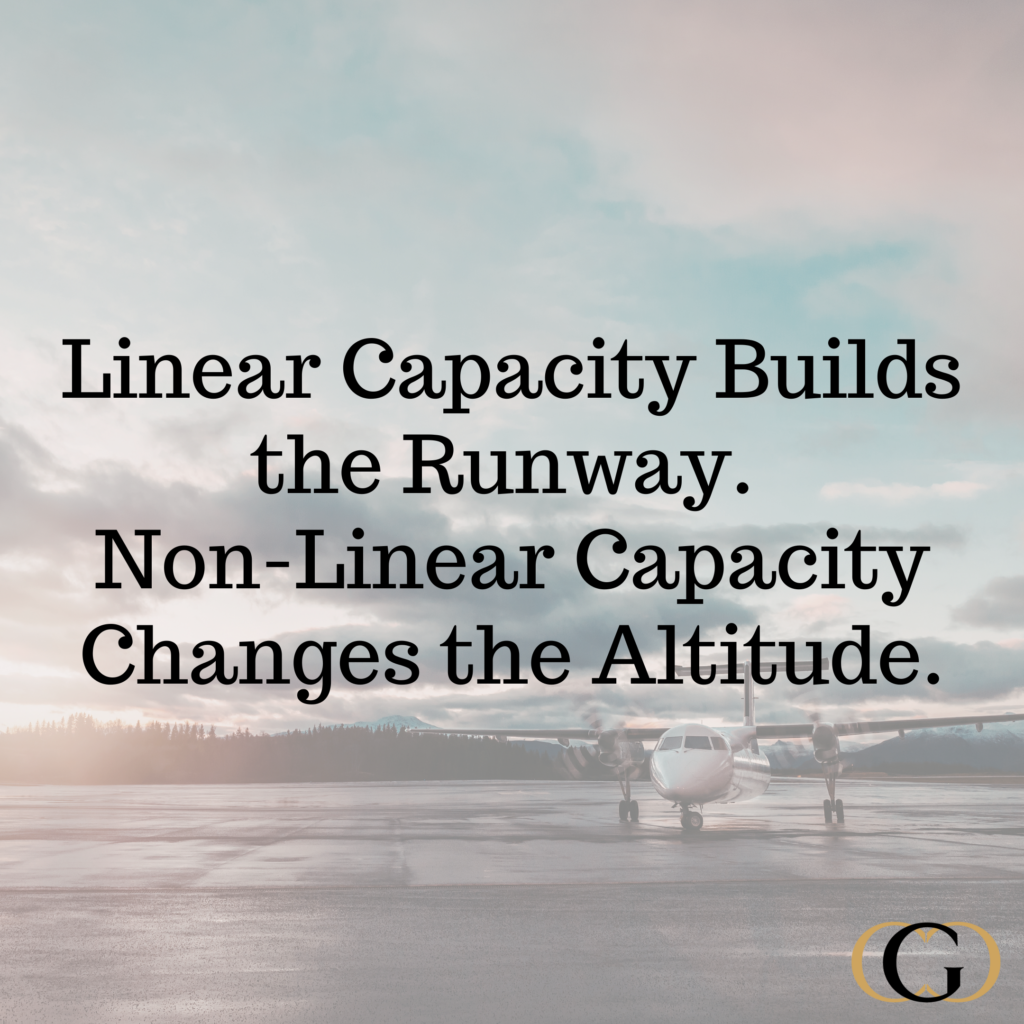
I’ve seen a lot of chat lately regarding capacity – specifically linear capacity versus non-linear capacity. It’s relevant to the collective shifts we are experiencing and also to the transformational arc of the Soul’d approach. However, and unfortunately, the difference between these types of capacity isn’t always defined clearly – potentially because part of the offering includes the definition. But, as you know, I don’t gatekeep here at Soul’d, so let’s look at the distinction in a simple, practical, and grounded way, because understanding this changes how you interpret your own growth.
Part 1: Linear Capacity vs. Non-Linear Capacity
Linear capacity says: “I can do more by adding more.” It assumes output increases in direct proportion to effort. It sounds like: “If I work more, I earn more. If I push harder, results come faster. If I optimize better, things stabilize sooner. If I manage everything well enough, uncertainty disappears.”
This model works in many environments, especially within jobs, school, structured systems, repeating workflows, and technical skill development. It’s predictable and reassuring. But it has a hidden cost: it requires constant exertion to sustain momentum.
Non-linear capacity says: “Things expand when alignment stabilizes.” It works differently. Output increases because of positioning, clarity, timing, coherence, relationships, visibility, trust, identity stability, systems already built and energy availability – not just effort. It sounds like “One conversation changes everything. One idea lands and spreads. One offer becomes clear and suddenly converts. One shift internally reorganizes many external things. Momentum arrives in waves instead of increments.”
This model is how entrepreneurship, creative work, thought leadership, identity-based businesses, and methodology-based work (like Soul’d) actually grow.
Part 2: The Threshold Effect
If you’re someone, like myself, who has spent years operating in linear capacity mode by increasing discipline, optimizing routines, stabilizing systems, protecting energy and building structure, that work was necessary. Because linear capacity builds the runway. But if you’re an entrepreneur speaking to the truth of your heart as it relates to the strength of your work, you are operating in a non-linear capacity structure. Meaning: your growth won’t match the pace of the effort that built it, which is why a lot of people notice a gap between linear effort and non-linear response timing.
Linear capacity thinking says: “If I publish weekly for months, engagement should steadily increase.” Non-linear capacity reality says: “You publish steadily until recognition crosses a threshold – then engagement changes suddenly.” Not gradually. Suddenly. This happens in clusters, not increments.
However, because you’re not forcing momentum anymore, you are also not forcing timing. There are delays and lags, which can be frustrating and make you want to return to forcing. This is where people can get a little worried, and if I’m honest, I’ve been in this moment many times.
But what’s happening in those moments isn’t a pause in growth. It’s a shift in how growth arrives. Recognition is reorganizing before it becomes visible.
This is where trust stops being a feeling and becomes a posture. You’re no longer pushing results into place. You’re holding your orientation long enough for results to arrive through coherence instead of effort.
This is also where anchors, which I will talk about in a moment, help you live in expansion rather than resist and control it.
Non-linear capacity only feels like a delay if you’re measuring growth through effort. But it’s not a delay. It’s a threshold effect.
A threshold effect means change is happening the entire time, but results only become visible after a certain level of alignment, stability or readiness is reached. So instead of growth looking like this: effort → result → effort → result → effort → result, it looks like this: effort → effort → effort → effort → threshold crossed → results change suddenly. Nothing was wasted. Nothing was delayed. Nothing was failing. The system was reorganizing.
The system is reorganizing behind the scenes until recognition becomes possible. And once recognition becomes possible, movement accelerates quickly – not because something new was added, but because something finally aligned. Something finally clicked – within yourself first, and then in how the world responds to you.
And so when you are moving through essence-led expansion, and you’re assuming “nothing is happening.” What is actually true is that everything is reorganizing. During this phase, positioning stabilizes, clarity sharpens, identity becomes believable, nervous system capacity increases, message coherence improves, audience recognition accumulates quietly, and trust compounds before conversion appears. And then suddenly: movement.
Linear capacity feels like control, which is why we love it so much. Non-linear capacity feels like orientation, which is where you’re focused on your posture and positioning and readiness. This feels like surrender, which can also feel uncomfortable, but it’s rooted in trust, which is the root of an essence-led life and business.
So instead of thinking in a linear capacity fashion: “I must manage everything carefully,” you begin to orient your life to a non-linear capacity frame of mind, which says: “I position myself correctly and respond well.”
A threshold effect is when things are reorganizing beneath the surface until recognition becomes possible. And once recognition becomes possible, movement changes quickly; not because something new was added, but because something finally aligned.
Part 3: Anchors Stabilize Expansion Before Evidence Appears
I spoke about sunflowers in a recent Substack post, because I’m currently working on a paint-by-numbers sunflower painting, and I love it. Not just because sunflowers are deeply meaningful to me, but because the painting itself has been an anchor as I’ve built my own non-linear capacity. This process has been so transformative to me that this specific ritual of an anchor like this is included within my Mentorship offering that I provide for clients moving through expansion.
Anchors aren’t about holding yourself back. They’re about helping your nervous system stay steady long enough for change to become real. Because when something new is forming in your life or your work, your system needs continuity while your identity expands.
Without anchors, people try to rush the transition. With anchors, they learn how to live inside it.
And take it from me – entrepreneurship especially needs anchors. Because so much of the process is invisible. You’re making decisions before there’s evidence. You’re building structure before there’s feedback. You’re continuing before there’s confirmation.
Anchors help you stay with what’s true while results catch up. And most people underestimate how important that phase is. It matters more than most people realize.
The sunflower painting has absolutely helped me stay steady while something new is taking shape. And I think that’s what anchors are meant to do. Not hold us in place, but help us remain ourselves while life reorganizes around what’s becoming true.
This is the process of building non-linear capacity.
Part 4: Orientation Is What Allows Growth to Reach You
On the same topic of sunflowers, they hold an even deeper meaning here that I didn’t realize at first. They reflect non-linear capacity. If linear capacity thinks, “grow by effort,” sunflower capacity says, “grow by orientation.” Same soil, same water, same sun… but different direction equates to different growth.
Orientation though, is not a business strategy. It’s a way of relating to growth itself. It’s not effort. It’s not optimization. It’s not discipline in the traditional sense. Orientation means: placing yourself where what you’re building can finally reach you.
For example, I have personally oriented my business for recognition through calendar availability, publishing rhythm, entry point clarity, offering structure, newsletter navigation, relational bandwidth, etc. I didn’t force clients. I positioned myself so that clients could arrive through recognition. That’s orientation. I’ve oriented Soul’d so that people can recognize themselves within it and then choose to orient themselves to the methodology.
But I didn’t just orient my business, I oriented my entire life, through the Soul’d approach. I oriented myself towards nourishment, visibility, continuity, structure, truth, receiving, and expansion. And when someone begins orienting across domains like that at the same time, something very predictable happens next: their external life starts catching up faster than before. Because everything is finally facing the same direction.
So, in those moments of doubt, I don’t let it consume me, and I don’t let it linger. I attune to what’s true. I orient to what’s true. I become the sunflower and turn towards the light.
Part 5: Structure and Surrender Are Not Opposites
Non-linear capacity does not replace linear capacity. It builds on top of it.
I’ve been speaking to this through much of my content recently, but if you’re an entrepreneur who teaches predominantly effort-oriented practices, or an entrepreneur who teaches predominantly surrender-oriented practices, the new paradigm of marketing and manifesting we are now living in is going to be tough for you.
You can’t force your way to $10K months. You can’t float your way to $10K months.
Soul’d is for those who operate outside of both hustle culture and bypass culture. Soul’d doesn’t sit in between these two cultures, it sits beyond them.
If hustle culture says “effort creates results” and bypass culture says “surrender creates results,” Soul’d says: coherence creates results.
Soul’d is the culture of coherence, where structure and surrender stop competing and start cooperating.
That’s an entirely different operating system. It’s essence-led expansion.
Just as with the vessel metaphor that I love to use – you must be contained, within a structure, to allow flow to move. The environment within you and around you must be structured and stabilized. Otherwise, your nervous system will be in a constant state of expansion and contraction, because you don’t have the capacity to hold sustainable growth – whether you’re forcing too much or floating too much.
Essence-led expansion requires balance of both structure and surrender.
In Closing: Capacity Changes the Way Growth Arrives
Linear capacity teaches you how to build stability. Non-linear capacity teaches you how to receive expansion. Most people try to choose between the two. But sustainable growth happens when they begin working together.
Structure creates continuity. Orientation creates recognition. Anchors create stability. And coherence allows momentum to compound instead of spike. This is why growth eventually stops responding to effort alone. It begins responding to readiness.
So if things in your life or business feel like they are reorganizing instead of accelerating right now, that doesn’t mean nothing is happening. It often means your capacity is changing. And when capacity changes, results rarely arrive gradually. They arrive all at once. And when that happens, it won’t feel like luck. It will feel like recognition.
Click on the link above to watch the latest episode of Soul’d, or listen to it here on Apple Podcasts: https://podcasts.apple.com/us/podcast/sould-by-christina-giordano/id1760357148 or here on Spotify: https://open.spotify.com/show/2EXmS5t7jgohMD4P4ZzKEu
Subscribe to Soul’d for a deeper dive: https://christinagiordano.com/get-connected/
Begin with the foundation. Soul’d: Business That Begins Within is an essence-led framework for building a business that grows without self-abandonment. Learn more: https://christinagiordano.com/get-guidance/the-e-book/